

Stop Selling Subscriptions. Start Selling Solutions
No one wants more content, paid or otherwise

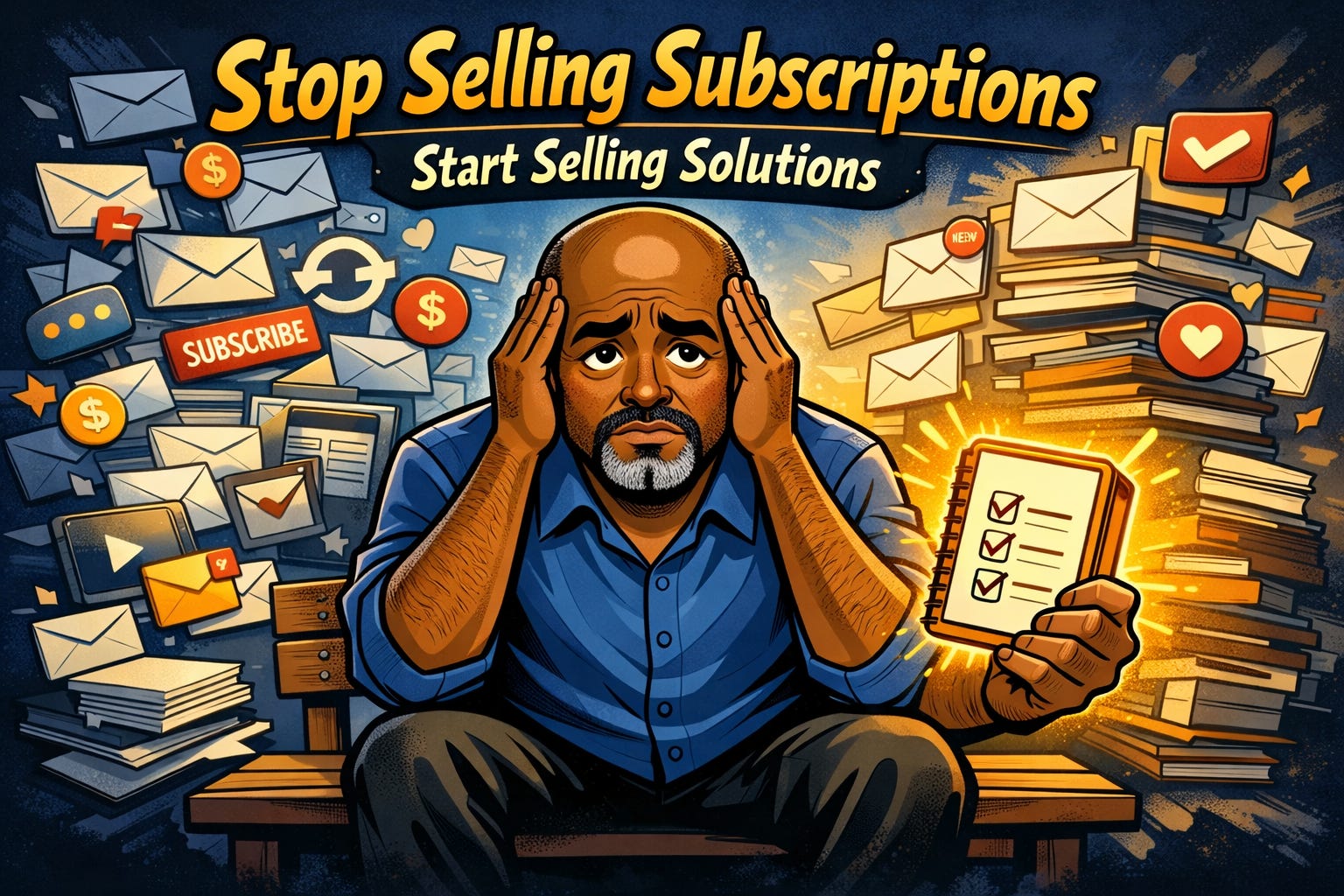
When I first joined Substack, I was like a kid in a bookstore. I was excited, inspired, maybe even a little idealistic. I subscribed to newsletters like I was building a dream reading list. I was thrilled to support other writers and be part of something soulful and smart.
And I was told I could sell my newsletter. People would pay me to write. Hallelujah!
But it didn’t take long before I felt that creeping sense of overwhelm. Which ones should I pay for? How many newsletters can I read in a day?
Not from junk. It was good content. Thoughtful, honest, well-crafted essays… sitting unopened in my inbox. I realized: I didn’t need more content. I needed more space. You probably feel the same way. So do your subscribers.
So if you're here thinking your way to paid subscribers is by pumping out more behind-the-paywall posts… take a breath.
You're probably solving the wrong problem. No one wants more content.
Rocket Money Will Sell You a Subscription… to Cancel Your Subscriptions
We’ve hit peak subscription fatigue. One of my most loyal supporters cancelled her subscription, not because she didn’t want to pay me. She just wanted to keep track of what money was going out.
There’s now an app—Rocket Money—that makes a business out of helping you cancel all the subscriptions you forgot you had. (And yes, they charge you a subscription to do it. Ironic?)
Let that sink in:
They’re selling you a subscription to cancel your subscriptions.
Now imagine trying to convince someone—already overwhelmed with streaming services, apps, tools, memberships—to pay you $5/month for more things to read.
It’s a tough sell, even if your content is outstanding.
About 1 in 100 People Will Pay
Here’s what I’ve seen, and it tracks with what others report:
Roughly 1-5% of your readers will convert to paid. That’s about one in every hundred subscribers. My percentage is around 2%. But if you’re not a well known author, your percentage is likely going to be in that 1-3% range. For those of you who are not math nerds like me, that’s 100 subscribers to get one paid. 1,000 subscribers to get 10. At $5/month, it’ll take 1,000 subscribers to make $50/month.
Real-world data shows that 2–5% is average, but 1–3% is more typical, especially for smaller lists or niche writers. And guess what?
It’s likely if you’re a little guy, people aren’t paying for exclusive content.
They’re paying because they want to support your work.
They resonate with your voice. They feel seen, supported, and understood.
That’s what they’re funding—not perks.
And yet, there’s a catch…
So, how do we make money?
Business coaches will tell you to create “high ticket offers”. Great. But those are hard to sell. So, we create courses.
I’ve spent hours building elaborate courses—writing scripts, shooting video, editing, uploading, organizing multi-module journeys.
And then… barely anyone finishes them.
It’s not that the content was bad. It’s that people are stretched thin. They’re tired. They start strong, but the finish line fades as life piles on. I’ve seen it time and time again.
And it’s backed by the data:
📚 80–90% of online courses go unfinished.
So all that energy I spent building more actually delivered… less.
That’s not sustainable. For me, or for the people I’m trying to help. They’re frustrated because they paid for something they’ll never finish. I’m disheartened. It sucks all around.
💡 Microconversions Over Subscriptions
Subscriptions sound nice, right? That steady drip of passive income. But the reality is… they’re not all that passive.
There’s a constant pressure—on both you and your reader—to justify that monthly fee.
Every month, your reader silently wonders: “Is this still worth it?”
And every month, you feel like you have to earn it all over again.
That’s a treadmill. And it’s exhausting.
That’s why I’ve started focusing on microconversions instead—small, clear transactions with defined expectations.
No recurring billing.
No bloated “subscriber-only” content strategy.
Just: here’s a specific thing that solves a specific problem. Buy it if it helps.
I opened a Stan Store a few months ago and started filling it with bite-sized products. Then I began writing short posts and making quick videos that point readers to exactly what they might need—right now.
It feels good. Honest. Focused.
And my customers? They know what they’re getting. They use what they buy.
With microconversions, there’s no pressure to “keep providing value.”
You already did.
🔁 The Shift: From Content Creation to Problem Solving
Here’s what works better—for both you and your reader:
✅ Pick one tiny, real problem.
✅ Solve it quickly, simply, and clearly.
✅ Deliver it in a format that’s easy to use and finish.
I once paid $27 for a Canva hacks guide. A few quick tips, some screenshots, and I was off and running. It’ll take me a few days to finish it. But I will because I can see the finish line and it’s providing me things I can use immediately.
There’s a creator I’ve bought four small products from. She specializes in beautiful, functional Google Docs and Sheets templates. Each one solved a single pain point. Each one was under $30, with some costing as little as $7. And because I used them—and they worked—I continue to buy more.
Meanwhile, the creators who sold me bloated courses I never finished? I’ve unsubscribed from their newsletters. I won’t buy more. Quietly. No hard feelings. Just… I don’t have time for that anymore.
🤝 Build Trust, Not Bloat
If you're on Substack, here’s what I’d suggest:
Use your free newsletter to build trust and connection.
Let your writing show your heart, your voice, your insight.
Then, instead of gating more content behind a paywall, offer standalone, affordable solutions.
Think: PDFs, checklists, swipe files, short templates.
Help people accomplish something, not just read something else.
🧠 Storytellers Doing This Beautifully
Here are a few creators walking this path with grace:
📝 Anne-Laure Le Cunff (Ness Labs)
Built a wildly successful audience by sharing accessible, thoughtful insights—and monetized through small digital products and community access, not gated articles.
🛠️ Marie Poulin (Notion Mastery)
Grew by giving away practical value, building community, and offering micro-products before launching a bigger course (that people actually finish).
🗂️ Kaleigh Moore
Shares high-value freelance writing tips for free, and monetizes through templates, 1:1 sessions, and no-nonsense digital tools.
None of them led with subscriptions. They led with helpfulness.
And that’s what made them trustworthy.
If You Want to Dig Deeper
These are worth reading if you want to understand the bigger picture:
📉 The hidden cost of all your subscriptions (Business Insider)
📊 Consumers want less choice, not more (TV Technology)
📚 Why 80–90% of online courses go unfinished (Learning Revolution)
Your Challenge: Create One Small, Useful Thing
Before you draft your next “premium” post or map out your mega-course, pause. Ask:
What’s one micro-problem your audience has today—something that’s annoying, time-consuming, or confusing?
Then build something that helps them solve that, in 15 minutes or an afternoon at most.
Make it easy to buy. Easy to use. Easy to finish.
You don’t need to lock content behind a paywall to get paid.
You just need to be useful. And human.
Want an example?
If you’re craving clarity and a gentle, realistic reset, I’ve created the Life Balance Workbook—a guided reflection tool to help you identify where you’re off-kilter, and how to take the next right step toward balance.
It’s simple, soulful, and only takes about 20 minutes to work through.
💬 Call to Action
What could you create this week that:
Takes 30 minutes or less to build
Costs less than a pizza
Helps someone make progress today
Builds trust that leads to more sales down the road?
Make that. Sell that. Let your newsletter be your invitation—not your product.
Because the real value?
It’s not in more content.
It’s in helping people get what they need—and move forward.
p.s.- I still offer paid subscriptions. Why not? I just don’t overpromise and I’m very clear about what people will get.
If you loved this article, why not buy me a coffee? Every little bit helps me keep this going.
